
Cumberland County Criminal Court Cases
The Cumberland County Court of Common Pleas hears felony and misdemeanor matters that advance beyond the preliminary stage. Its Clerk of Courts keeps the criminal docket and the filed papers. Ten Magisterial District Courts, often called MDJs, handle criminal complaints, preliminary arraignments, bail, and preliminary hearings. They also decide summary matters. The county publishes a municipality-to-district table because the correct lower court depends on where the case arose, not merely on a mailing address.
A case held for court moves from an MDJ to Common Pleas, where the District Attorney may file an information. An information is the formal charging paper used for an ordinary Pennsylvania trial-level prosecution. Appeals can appear in Pennsylvania appellate searches. Federal charges follow a separate path in the U.S. District Court for the Middle District of Pennsylvania and do not become Cumberland County court files.
The office name matters at the courthouse. The Clerk of Courts is the criminal-file custodian. The Prothonotary handles civil records, while the Sheriff handles security, process, warrants, and transport. Asking the wrong counter for a Cumberland criminal pleading adds delay and may lead to a record that answers a different question.
Cumberland UJS Case Search Keys
The official Unified Judicial System of Pennsylvania Web Portal separates Common Pleas searches from Magisterial District Court searches. A complete docket number is the safest key. Participant names can return people with similar names, so county, court type, filing dates, and case category should narrow a broad result. An OTN, or offense tracking number, can connect an arrest cycle to a court matter when it appears in the record.
The UJS search screen and its Cumberland County filters are visible in the official portal image below.
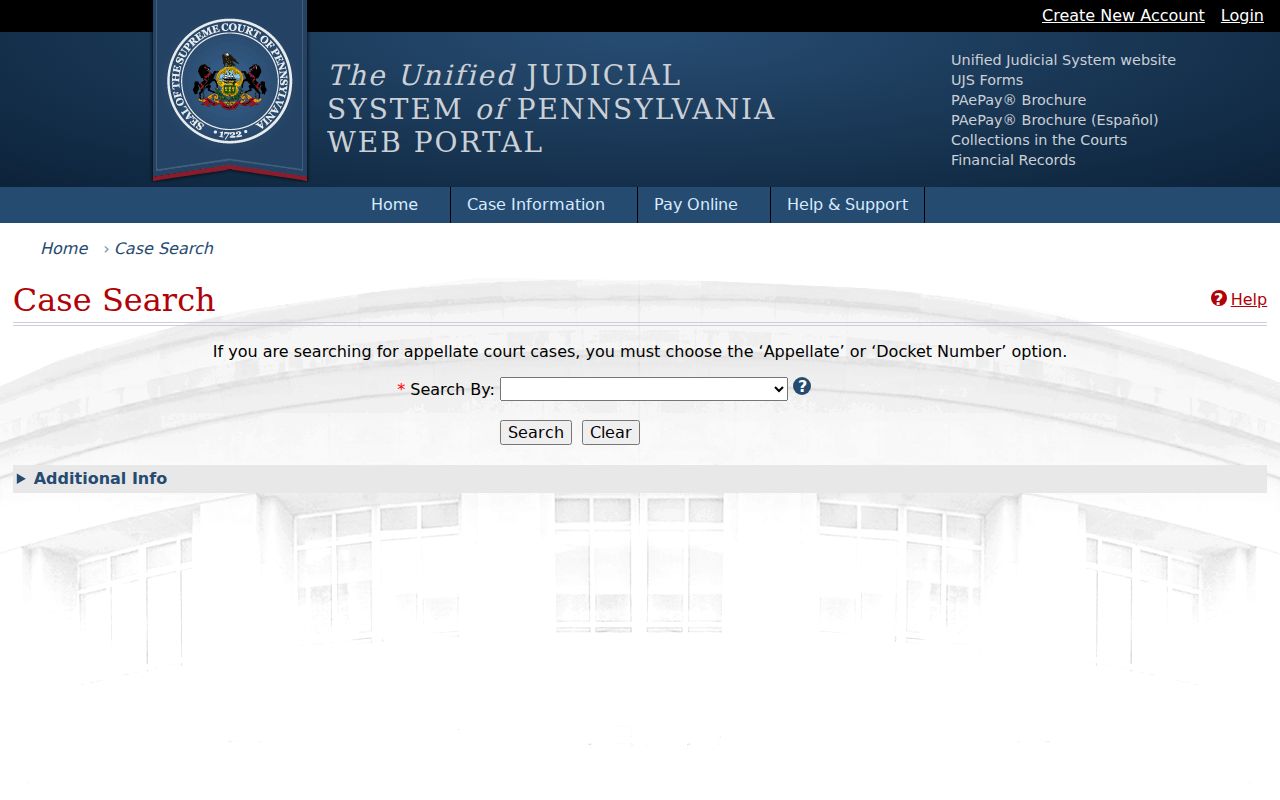
The separate tabs matter because an MDJ complaint and a later Common Pleas docket may use different numbers while describing the same prosecution.
Searching Cumberland County Case Records
Use the free docket index first, then move to the office that holds the paper. The Pennsylvania courts case-information service explains both electronic searches and requests for paper court records. This sequence avoids asking the Clerk to identify an unknown case and helps the requester name the precise document needed.
- Choose Common Pleas or Magisterial District Court in UJS, then select Cumberland County and the criminal category.
- Enter the complete docket number when known. Otherwise, use a participant name with filing dates and spelling variants.
- Open the likely result and verify court, filing date, charges, status, and related lower-court references.
- Note the docket number, document title, and event date for each paper needed from the file.
- Request Common Pleas papers from the Clerk of Courts or preliminary and summary papers from the listed MDJ office.
| Field | Type | Use | Search note |
|---|---|---|---|
| Court type | Tab or menu | Required | Choose Common Pleas or MDJ before entering details |
| Docket number | Text | Conditional | Most exact route when the full number is known |
| Participant name | Text | Conditional | Try full legal name and sound spelling variants |
| County | Menu | Recommended | Select Cumberland to remove other Pennsylvania counties |
| Case category | Menu | Optional | Use criminal at Common Pleas; MDJ also offers traffic and non-traffic |
| Date filed | Date range | Optional | Helps separate common-name matches |
The official case-information page shown below reinforces the difference between searchable docket information and a paper-record request.
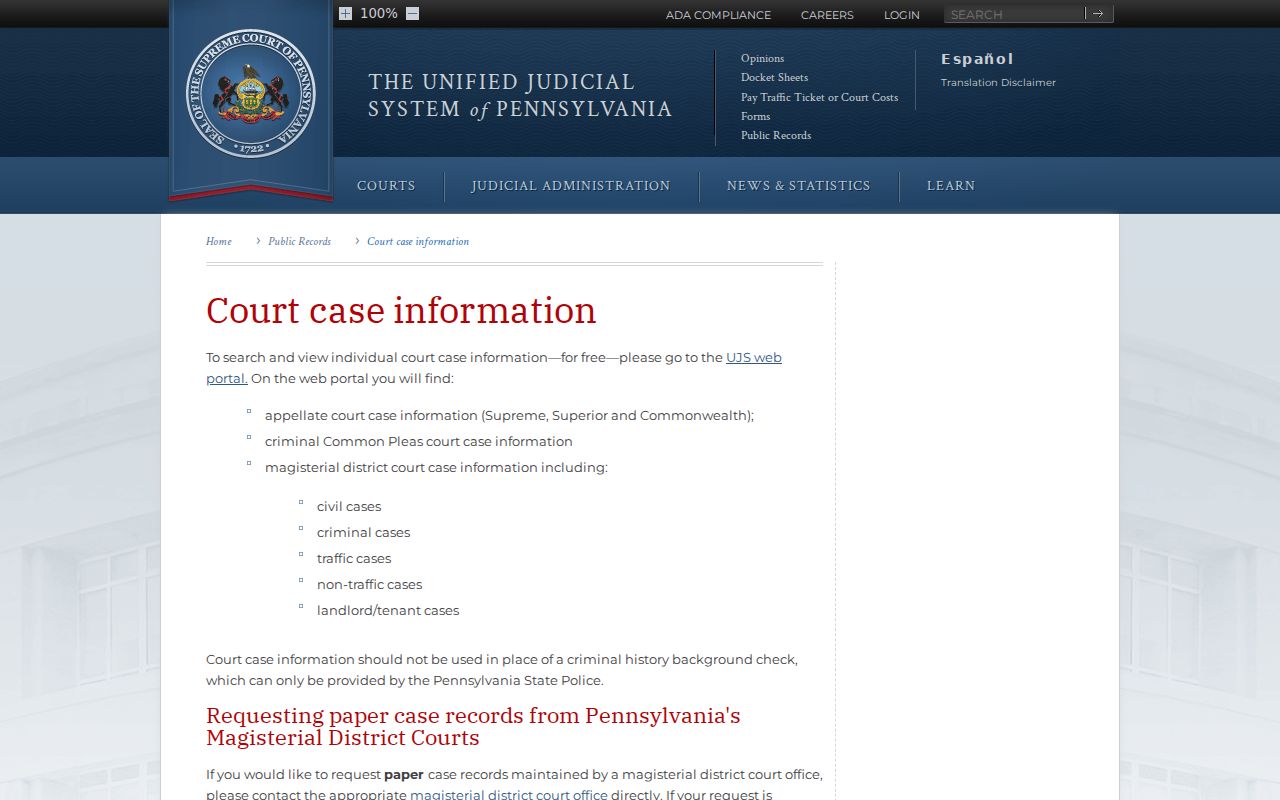
That split is crucial in Cumberland County because the web index is not the complete criminal file.
Cumberland Criminal Papers Stay Offline
Cumberland County ended public web access to criminal document images because electronic disclosure could not feasibly meet Pennsylvania Supreme Court access restrictions. The Clerk's criminal record search service provides public terminals and file retrieval at Room 205, 1 Courthouse Square, Carlisle. The office is open Monday through Friday, 8 a.m. to 4:30 p.m., and can be reached at 717-240-6250. Attorneys of record and authorized proxies may use authenticated PACFile access, but that does not create general public image access.
The county's local search-service screen is captured below as the source for the counter and terminal route.
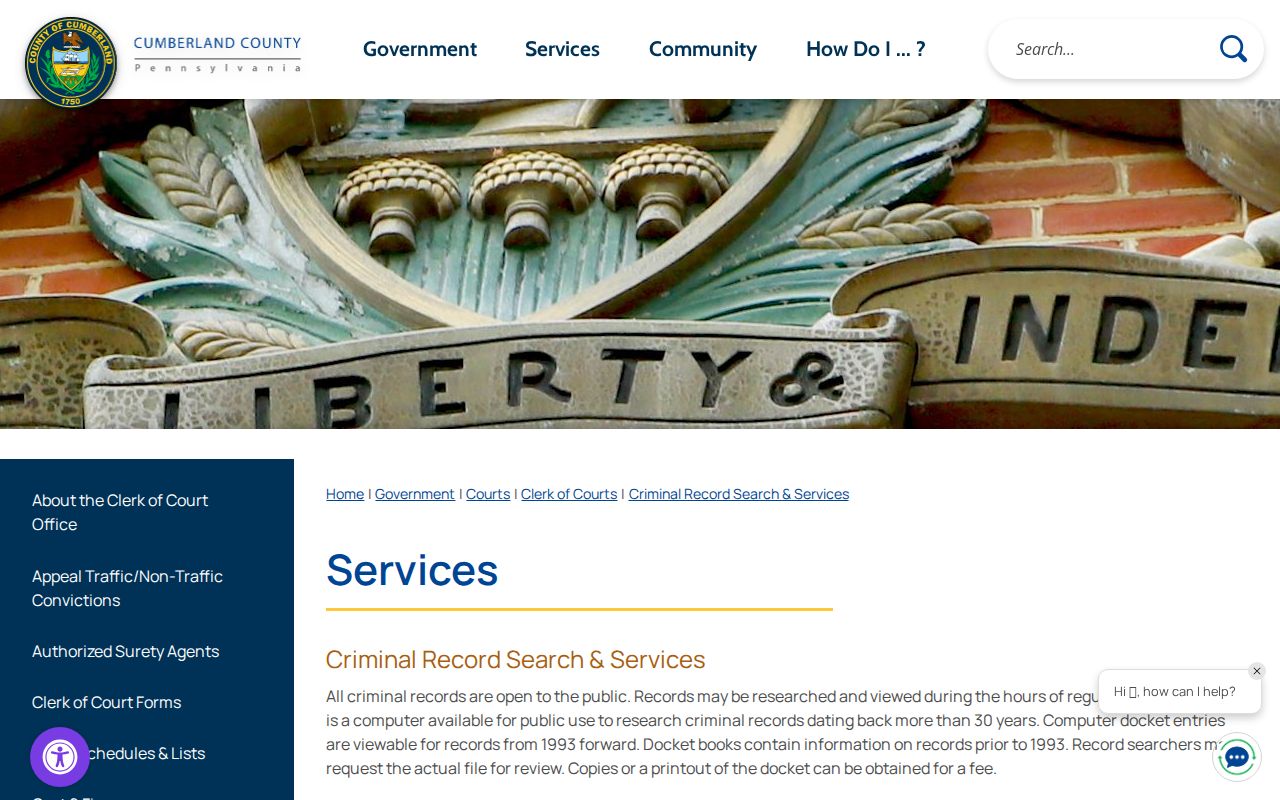
Bring the docket number and ask for a named pleading, order, or certified disposition. Older records may require staff retrieval rather than an online image.
Inside a Cumberland County Case File
A docket is a chronological index. The case file supplies the papers behind those entries. Read outcomes count by count because one Cumberland County docket may contain guilty, dismissed, withdrawn, and nolle prosequi results. Nolle prosequi means the Commonwealth chose not to continue that count, subject to court procedure. It is not a conviction.
| Header | Docket number, filing date, Cumberland County court, caption, and status |
|---|---|
| Charging paper | Complaint at the MDJ stage and information after transfer to Common Pleas |
| Charges | Offense, statute, grade, count sequence, and a separate outcome for each count |
| Bail | Type, status, amount, and relevant dates when public |
| Proceedings | Hearing type, date, judge, location, motions, pleas, and trial events |
| Disposition | Guilty, not guilty, dismissed, withdrawn, or nolle prosequi labels |
| Sentence | Sentence components, dates, probation or confinement, and order references |
| Financial entries | Public assessments and balances, without protected account information |
A certified disposition is often the best paper for reconciling a court result with a Pennsylvania State Police criminal-history cycle. The docket alone may not show every detail needed to correct a repository mismatch.
Older Cumberland Criminal Docket Books
The Clerk provides courthouse terminals for indexed records, but older Cumberland County criminal cases do not all begin as modern electronic files. The research identifies docket books as the fallback for cases before 1993. Staff may then retrieve the actual file. This is a different task from a broad name search, and an exact year or docket reference can save time.
Current modernization work includes scanning 1990 and 1991 files into archival PDF/A. That preservation project does not change the public rule: criminal document images remain unavailable through the county website. Call before a visit if the request is large, involves certification, or requires an older volume. The office may need time to pull and review papers.
A researcher working from a name alone can use the Clerk's paid search service, but a docket number remains more reliable. Names change, spellings vary, and several people may share one name. Pair the docket with the filing year, charge, and court level before ordering copies.
How a Cumberland Criminal Case Moves
A police complaint starts the judicial trail. An MDJ conducts a preliminary arraignment and addresses bail. At a preliminary hearing, the Commonwealth must show probable cause for a charge to continue. “Held for court” means that threshold was met; it does not mean guilt was proved. The District Attorney can then file an information in Common Pleas. Formal arraignment, discovery, motions, and pretrial proceedings follow as needed.
Case flow: Charges Filed › Arraignment › Pretrial › Plea or Trial › Disposition › Sentencing
Not every Cumberland County case uses each step. Counts may be withdrawn at the preliminary hearing, resolved by plea, tried, dismissed, or ended through another lawful disposition. A post-sentence motion or appeal can add later entries. To compare the earlier custody event with the filed charges, use the separate Cumberland County arrest lookup and then return to the court docket for the final result.
Reading Cumberland Case Dispositions
Case status and charge disposition answer different questions. A docket marked closed may still contain several counts with distinct outcomes. “Dismissed” means a charge was terminated. “Withdrawn” indicates the prosecution did not continue it at that stage. An acquittal is a not-guilty result after adjudication. A guilty plea or verdict supports a conviction. Read the date and the exact count beside each label.
Bail also is not a finding of guilt. Recognizance relies on a promise and conditions rather than secured payment. Surety involves third-party backing. Later changes can make an old docket line stale, so use the newest entry or order. If UJS and another official record conflict, obtain a certified disposition from the Clerk before asking PSP to review its criminal-history data.
Cumberland Case Access and Restrictions
The Pennsylvania Supreme Court public-access policies govern judicial records. They protect Social Security numbers, state identification numbers, account credentials, court-sealed material, drafts, and information whose disclosure could harm privacy, security, or orderly justice. Victim and minor details also receive protection. A redacted copy remains public with fields removed; a sealed file is withheld under a court order or legal rule.
The Pennsylvania Right-to-Know Law is not a substitute for the Clerk or an MDJ. Start with the judicial custodian. If no case appears, check spelling, dates, county, court level, and whether the matter is too old for the electronic index. Juvenile proceedings follow separate rules. Public absence may also reflect limited access, expungement, or another restriction, so it should not be treated as proof that no record ever existed.
Cumberland Court Copy Costs
The 2026 Clerk of Courts fee schedule lists a $24.75 criminal name search, copies at $0.50 per page, and certification or exemplification at $13 plus copying. An expungement or limited-access petition is listed at $155, with added miscellaneous and automation charges for a matter not already at Common Pleas. Confirm the total before ordering because the document count and docket posture affect it.
The official fee page shown below is the source for these Cumberland County charges.
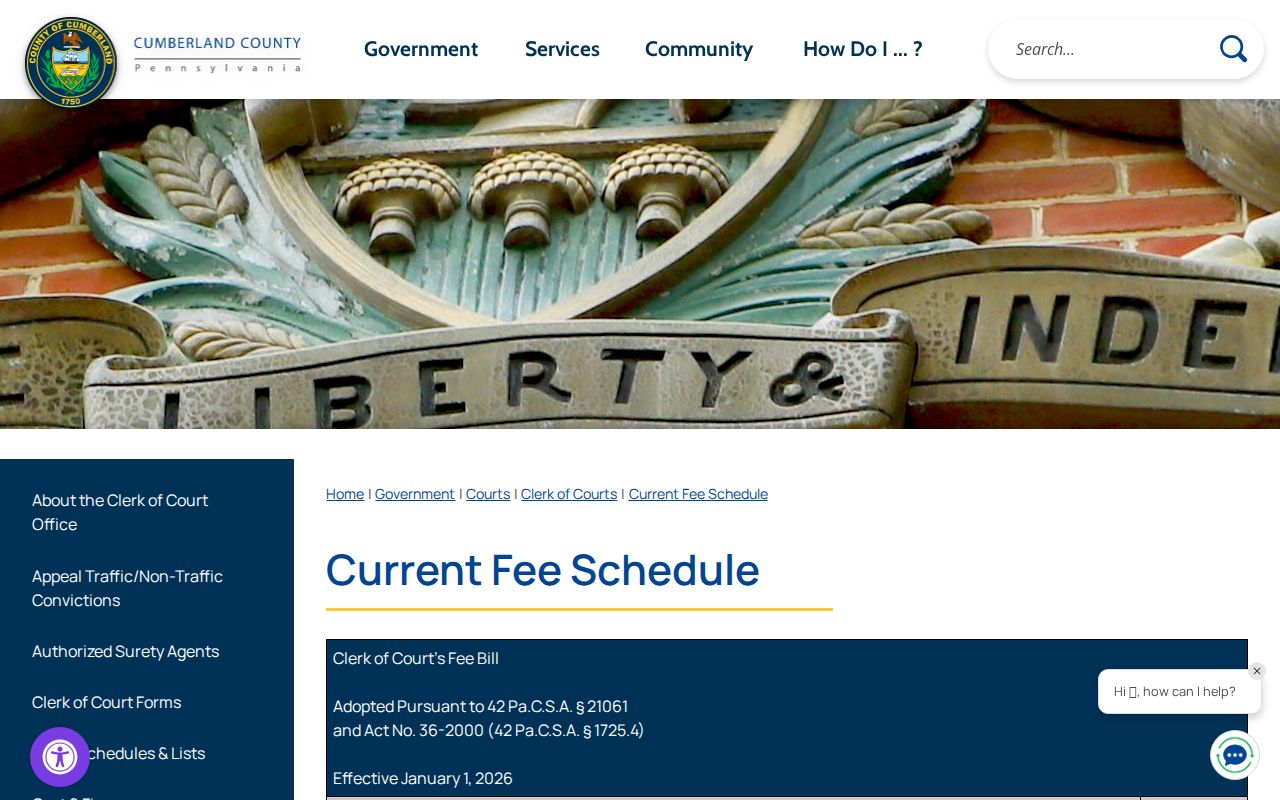
A plain docket print and a certified disposition serve different needs. State which one is required so the Clerk can quote the right charge.